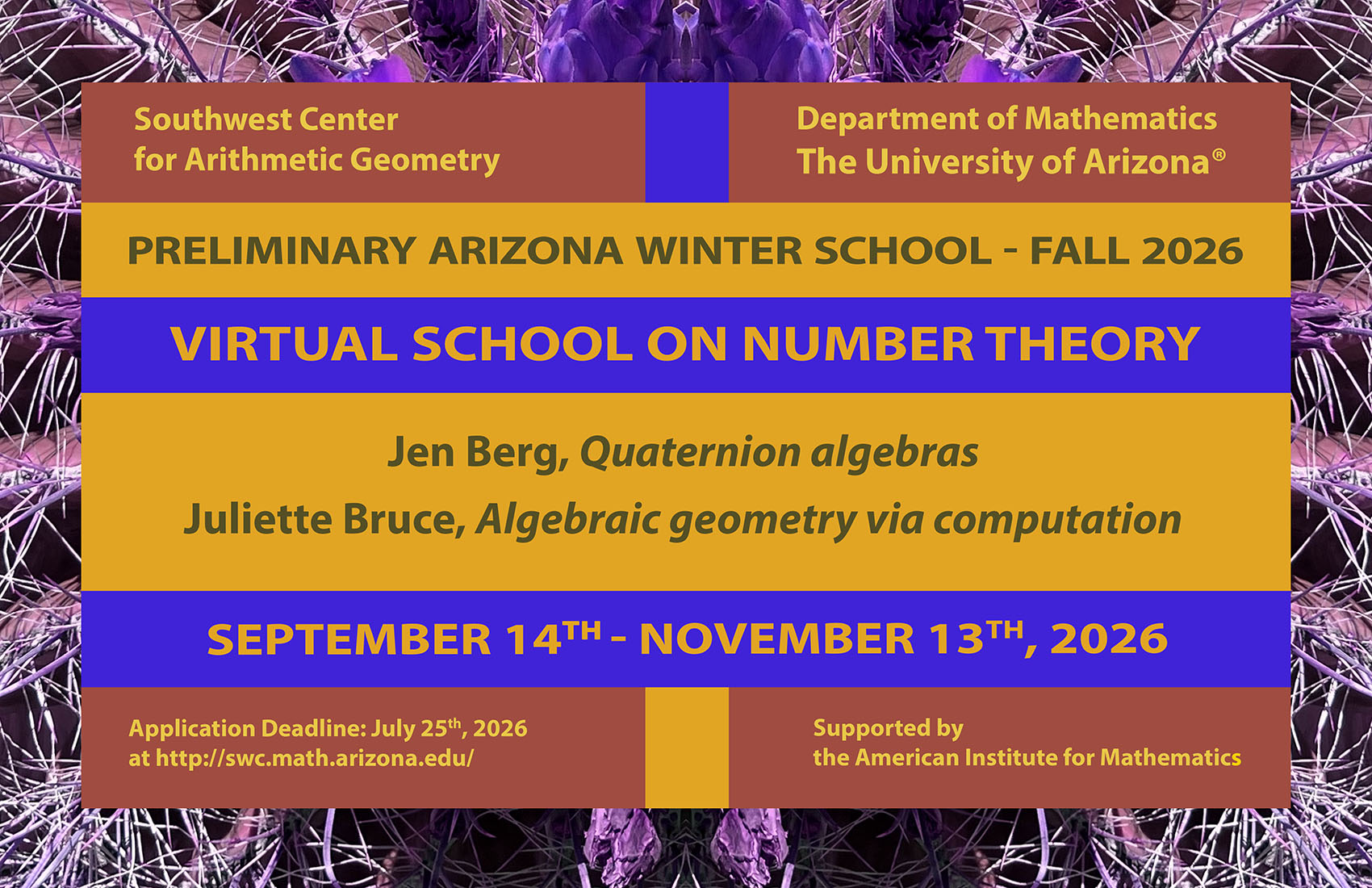
Preliminary Arizona Winter School 2026: Quaternion Algebras and Algebraic Geometry via Computation
The Preliminary Arizona Winter School (PAWS) is a virtual program on topics related to the upcoming AWS, with an intended audience of advanced undergraduate students and junior graduate students.
Format: The program will run for 9 weeks, alternating between 5 weeks of lectures and 4 weeks of problem sets (with a TA session)
Each lecturer will be accompanied by graduate student assistants, who will be in charge of writing weekly problem sets and facilitating weekly, hour-long problem solving and discussion meetings with groups of students.
Quaternion algebras will assume only a first undergraduate course in abstract algebra as a prerequisite. Computational algebraic geometry will assume fluency with algebra at a beginning graduate level such as groups, rings, fields and modules, but will not assume any prior knowledge of algebraic geometry.
The school will feature an online (Discord) discussion board where students can ask questions and interact with the speakers and assistants outside of scheduled meeting times.
We will facilitate additional virtual events, some purely social to build a community, and some more structured sessions on timely and pertinent topics like "What is graduate school in Math like?", "Tips for applying to graduate school this Fall," "How do I navigate the first year of graduate school?" "How do I look for an thesis advisor?", "How to get the most out of the upcoming AWS."
We encourage undergraduate students to take their PAWS course as an independent study with a faculty member at their home institution.
- Organizers: Brandon Levin, Padmavathi Srinivasan, and Isabel Vogt (main organizers) with Renee Bell, Serin Hong, Anthony Várilly-Alvarado, and Hang Xue
- Please contact aws@swcmath.org with any questions.
- Funded by the American Institute of Mathematics.
September 14th — November 13th, 2026
PAWS 2026 consists of two concurrent lecture series.-
Jen Berg: Quaternion algebras
- Notes
- Video:
- Problem Sets:
-
Juliette Bruce: Algebraic Geometry via Computation
- Notes
- Videos:
- Problem Sets:
Hamilton famously discovered quaternions in 1843. Today quaternion algebras remain important in many areas of mathematics, from number theory to computer vision, where they offer an efficient framework for calculating rotations. This course will explore some of the structural properties of quaternion algebras and their connections to number theory.
A quaternion algebra is a four-dimensional vector space over a field, endowed with a non-commutative ring structure. Just as the complex numbers extend the real numbers by adjoining an element i (where i2 = -1), quaternion algebras are constructed by adjoining elements i and j to a field whose squares are nonzero elements in the field. Moreover, the elements i,j satisfy the non-commutative relation ij = -ji. We will explore relationships between quaternion algebras, division algebras (where every non-zero element has an inverse), and matrix algebras. Finally, we will examine their connection to solutions of certain quadratic equations.
This course will assume only a first undergraduate course in abstract algebra as a prerequisite, including some knowledge of fields and field extensions.
This course is an introduction to algebraic geometry from a computational point of view. We will study systems of polynomial equations by passing back and forth between their algebra, encoded by ideals in polynomial rings, and their geometry, encoded by the shapes of their solution sets. Along the way, students will learn how computation clarifies geometric questions and how geometric ideas guide effective algebraic or computational methods.
Topics will include affine varieties, polynomial ideals, the correspondence between algebra and geometry, and computational tools such as monomial orders, Gröbner bases, and elimination. The goal is to give a first entry point into algebraic geometry while emphasizing concrete examples, explicit calculations, and the interplay between theory and computation.
Computational algebraic geometry will assume fluency with algebra at a beginning graduate level such as groups, rings, fields and modules, but will not assume any prior knowledge of algebraic geometry.
-
Assisted by Problem Session Leaders:
Matt Broe, Xinyu Fang, Divyasree C. Ramachandran, Alexander Wang (Berg), and Toren D'Nelly-Warady, Aidan Hennessey, Smita Rajan, James Rawson (Bruce)